Friday, May 3, 2013

Making fish of men: Where are artificial gills?

Image Source: zidbits.com

There’s a certain amount of god-playing when humans deign to stay underwater for days. But to developers of artificial gills, this is a practical solution for both an economy and a scientific world that are pushing submerged explorations into deeper reaches.

USA divers, in particular, welcome this breakthrough as sea-borne job opportunities multiply. The country also prides itself in hosting an extensive network of divers who participate in marine contracting and non-profit services such as search and rescue operations for coastal disasters.

Diving has a strong hold in this country, with non-profits like Phil Newsum’s Association of Diving Contractors, International (ADCI) participating with federal agencies in a gamut of diving-related operations. One of the most compelling arguments for funding the invention of artificial gills may be search and rescue operations, such as that ADCI had to lead in Minnesota, following the collapse of a highway bridge into a river. The agency has a wealth of stories to tell its frequent partners, the U.S. Coast Guard and the Department of Labor, about long-haul diving operations.

Image Source: businessweek.com

Artificial gills broke into the scientific imagination back in 2006, when ”LikeAFish”, an Israeli inventor’s pet project, made headlines. The aptly named invention harvests oxygen from water through a closed-circuit system that pumps breathable gas in an airbag, a more ergonomic departure from the clunky oxygen tank.

This is the first viable model for artificial gills for which the inventor, Alon Bodner, sought patents. The U.S. military took no time to swim in the idea by taking Bodner’s concept for a run of other designs while retaining the battery-powered and airbag-facilitated mechanism of the invention. The device has also been baptized as “Microfabricated Biomimetic Artificial Gill System” or MBAGS, which could subsequently rearrange the SCUBA acronym into “self-contained open-circuit breathing apparatus.”

Image Sourge: spiegel.de

If all goes well, artificial gills are set to conquer commercial markets in this decade. Bodner’s invention had been given around 10 years since its inception to survive the testing channels and be adopted for commercial use. At least, this soaks sci-fi expectations that artificial gills will break out from the sides of the human neck.  


Phil Newsum is one of the most reputable divers in the United States aiding marine operations and providing divers’ training through his leadership of ADCI. More commercial diving information could be found here.

Wednesday, April 10, 2013

Underwater archaeology leads to worlds movies are made of

Underwater archaeology has the makings of a ruse. Archaeological sites demand prolonged surveys and excavations. Gathering fossils and artifacts could be an endless search. These operations will be cut short underwater, within the span of human breath. And while scuba gear stretches possibilities in netherworlds, it also has its limits.

Image source: newswatch.nationalgeographic.com
Still, it’s a promising method that tracks history where it passed. Submarines and remote sensors could be deployed for more explorations, but these could not replace that moment of pure scientific insight that connects clues and artifacts to each other. Human discernment, first of all, points out “submerged cultural resources”. These are sites bearing the imprints and other evidence of humanity’s existence. Shipwrecks, geological formations, and historical remains of monuments are examples.

Image source: guardians.net
Despite its risks and logistical constraints, underwater archaeology is regularly practiced. It has been a great service in bringing to surface prehistoric upheavals, such as early migrations to the New World and bygone maritime cultures in Northern Europe.

Shipwrecks are easy points of interest. The muted splendor that surrounds sunken vessels and battleships is of a cinematic quality that writes its own screenplay. It is not by accident that James Cameron imagined a love story and a billion-dollar remodeled ship after hauling Titanic up for air. The sea’s detritus has a way of preserving secrets of the past and lending an aged kind of romanticism to how historians interpret it.

Image source: unesco.org

Underwater archaeology naturally demands scuba training. Most archeologists who have been involved in land digs contend with this problem when the historical trail leads them underwater. Phil Newsum and the Association of Diving Contractors International can assist in training, particularly in deep sea diving. For more information, visit this Facebook page.

Thursday, March 14, 2013

Guam's extraordinary underwater critters

The glut of tourists flying in for the Caribbean’s famous dive spots has seasoned divers looking for other watering holes. The vast Pacific reassures them of the supply of open water. Guam is one of those diving spots that have outgrown ersatz tourism and come out as stars of their own.
Image source: commons.wikimedia.org

It would take special dives to reconnoiter with the renowned underwater critters, numbering in thousands of fish species. Guam has dozens of diving spots, popular in their own right for specific features. The Blue Hole is a natural choice for underwater archaeology, a 60- to 300-ft. plunge with sightings of the World War II wrecks of the SMS Cormoran (a German vessel) and the Tokai Maru (a Japanese one). A way’s side from the island’s northern coast, divers negotiate a 100-ft. dive in search for the Napoleon wrasse, a lumbering humphead with, reportedly, an amicable mien that balances out the thrill of dealing with non-malicious shark species. It also lurks among uncorrupted corals, of the kind Australia might put in tourism campaigns, but they’re stashed in a secret world only experienced divers could maximize.

Image source: commons.wikimedia.org


Over 20 new species of mollusks are also clacking against the sea wall. Amateur divers can content themselves with shallow acquaintance: 30 feet into a dive spot called the Blue & White, invertebrates slither around for a primordial fish eyeview. Shy of those, schools of pyramid butterfly fish are already a magical scream for first-timers.

Image source: commons.wikimedia.org


Phil Newsum is the executive director of the Association of Diving Contractors International, Inc., which promotes safety measures in commercial diving. More diving features here.

Monday, February 4, 2013

Of diving sites and marine protected areas

Several days ago, when the USS Guardian ran aground on the Tubbataha Reef, the issue of guarding protected marine areas has become alive anew.

Image source: tripadvisor.com
Although both parties chose to remain silent about the matter, speculations have spread like wildfire on the Web: that the minesweeper’s commander has violated certain marine and environmental laws by crossing protected area borders and allowing his troops to take pleasure in plunging onto the restricted Palawan ridge.

But this still remains an allegation that needs concrete confirmation.

You can’t just dive anywhere

Image source: nationalgeographic.com
If a well-decorated marine officer has obtained no special treatment regarding the violation of protected area laws—since he and his troops are under investigation—this shows that no one is above the law. Diving enthusiasts aren’t allowed to dive anywhere they like and as they please. Diving laws may differ substantially from country to country. Typically, diving proscriptions are implemented for the protection of sea areas declared legally as natural marine resources where a number of endangered and unique species are present, or historic places where rehabilitations and scientific explorations are currently being done.

Nonetheless, the dilemma of being caught and put to public infamy could easily be avoided. Diving, as it is a very serious activity, should always be associated with firms that ensure high standards of safety for underwater operations and believe in the idea of providing students and clients excellent diving education.

Diving companies like the members of Phil Newsum’s ADCI know very well where the best and safest diving places on earth are.

Image source: best-diving.org

More updates on commercial diving and related topics can be accessed at this blog.

Sunday, January 6, 2013

The Netherlands: Fugro Develops New Version of DeepWorks ROV Simulator

This article was taken from www.subseaworldnews.com. For the full article, click here.

The Netherlands: Fugro Develops New Version of DeepWorks ROV Simulator

Fugro has developed a new version of its DeepWorks ROV simulator for the Saab Seaeye family of electric ROVs, supporting console integration of the Seaeye Tiger, Lynx, Cougar XT and Panther XT/XT Plus models. To cater for the training needs of a mixed fleet of ROVs, Fugro Operating Companies in UK, Singapore, UAE, Brazil, and Australia will be the first to benefit as an enhanced set of training configurations is rolled out across the company.

DeepWorks now allows rapid building and evaluation of new electrical ROV configurations, helping operators find the best arrangement and mountings for cameras, sonars and tooling while ensuring the vehicle remains dynamically stable. As the range of missions electric ROVs undertake grows, DeepWorks offers a very cost effective way of building and testing multi-mission capability.

For pilot training, the most important feature is replication of the Seaeye overlay which tells the pilot where the ROV is, its depth, pitch and roll and camera tilt angle. Replicating the actual user interface means that when pilots go offshore the console feels immediately familiar and missions can be performed as practised. Other built-in features to improve pilot skills and responses include independent viewpoint control, sonar interpretation and fault simulation at any point in the mission.

“Our investment in designing DeepWorks as a versatile simulation platform capable of providing simulation of any type of ROV is now paying off,” said Dr Jason Tisdall, Fugro’s Robotic Technologies Business Line Manager. “In just a few months we have integrated DeepWorks with the Saab Seaeye surface and hand control units, and delivered an ROV pilot trainer with true electric thruster response, accurate navigation overlay and realistic training scenarios for five of the most popular models of Saab Seaeye ROV.”

Accurate electric thruster modelling gives the vehicle true behavioural responses to pilot demands. This creates the highest levels of realism when training and rehearsing key mission tasks such as docking, navigation by camera and by sonar, close inspection or tool deployment. Thrusters have initially been tuned for the Seaeye Tiger ROV, with other models to follow.

DeepWorks allows trainers to assess pilot skills by determining how long it takes them to complete tasks, how smoothly they operate the controls, and how well they respond to faults and deal with hazards. DeepWorks can also be used for assessing the overall mission difficulty and skills competency required. This allows operators to manage their pool of pilots more effectively and target training better. A further benefit of the DeepWorks electric ROV simulator is a substantially lower price point than DeepWorks for hydraulic ROVs.

Sunday, December 9, 2012

Surface-supplied diving: Diving on the line

Image credit: wikimedia.org


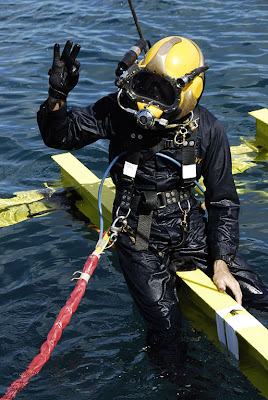
In the early days of professional diving, air was provided to the divers from the surface using a tube. Known as surface-supplied diving, this practice remains an important aspect of the commercial diving profession because of its crucial role in saturation diving. A rather complicated and costly process, surface-supplied diving is usually found in commercial and military applications where saturation diving may be necessary over time.

Organization officials such as Phil Newsum of the Association of Diving Contractors International stress the importance of this method in saturation diving, where divers are exposed to the high pressure conditions of deep-sea diving for prolonged periods.

Image credit: grancanariadivers.com


Surface-supplied diving has been present since the early days of the diving profession. The most recognizable form of this practice is the standard diving dress (also known as the “hard hat”), which has been in common use until relatively recently. Surface-supplied diving involves a diver to be provided air using a tube (the diver’s umbilical) that is linked to a diving compressor or a similar device.

Surface-supplied diving has many other key differences to scuba diving. Because they rarely need to float, surface-supplied divers usually wear weights. Both scuba divers and surface-supplied divers need pressurized air, which in the case of the latter is supplied through a mask or helmet linked to the umbilical.

Image credit: adc-int.org


More information on this and other diving topics can be accessed on this blog.

Sunday, November 11, 2012

Healthy White Coral: Who Knew?

The following article from The New York Times talks about the Leptoseris troglodyta, an unusual coral.

Over a decade ago, the coral researcher Bert Hoeksema found himself crossing from sunlit waters into an underwater cave in the Philippines. It was “like a big hole in a steep wall,” he said.


Leptoseris troglodyta, a coral species found living on the ceilings of caves near tropical reefs.
Leptoseris troglodyta, a coral found on the ceilings
of caves near tropical reefs in the Indo-Pacific region.

Wielding a camera and a diving light in the darkness, he looked up and saw strange clusters of white, delicate fungi-shaped polyps, like the ghosts of corals, carpeting the ceiling.
 
Most scientists associate that white hue with coral death, but this species was very much alive — and heretofore undiscovered.

“By being active in the field, we bump into new species by accident,” Dr. Hoeksema, a researcher with the Naturalis Biodiversity Center at the University of Leiden in the Netherlands, said in an interview. “It’s very thrilling.”

Twelve years later, his study of the albino coral has been published in the journal ZooKeys. The species, Leptoseris troglodyta (in Greek, troglodyta means “one who dwells in holes”), is known for inhabiting waters up to 35 meters (115 feet) deep, where the sunlight may be weaker and the ocean cooler, Dr. Hoeksema said.

What sets the species apart from other corals is the absence of zooxanthellae, a photosynthesizing algae that delivers nutrients. Such algae are also responsible for the bold swaths of color that characterize stony corals.

“The idea of white corals is not unknown at all,” Dr. Hoeksema said, referring to the bleaching events that increasingly cripple reefs. Decimated by waters that are uncomfortably warm, algae frequently undergo a mass exodus that drives the bleaching phenomenon.

Yet the whiteness of the new species is an anomaly, Dr. Hoeksema said, because it occurs naturally.
The lack of nurturing algae has left him flummoxed about how the species feeds. “Their only option is to catch food with their tentacles — they are very small, so I have no idea how they do that,” he said.

Dr. Hoeksema said that circulating particles of food cannot exactly drop onto a ceiling, which makes it harder for stationary creatures to gather nutrients. He speculates that some plankton bump into the corals. This inefficient method of feeding could account for the coral’s diminutive size – which in turn probably explains how it can colonize ceiling spaces where other, larger cave creatures cannot fit.

Since his discovery in 1999, Dr. Hoeksema has found the pale polyps on the ceilings of other Indo-Pacific caves and has established that Leptoseris troglodyta dwells across a region that overlies parts of the Coral Triangle, a mecca for marine researchers. It is host to over 70 percent of the world’s coral species and includes the waters of Indonesia, Malaysia, the Philippines, Papua New Guinea, Timor Leste and the Solomon Islands.

With that level of coral density, it is perhaps unsurprising that new species are periodically found. “We keep finding new species by going to remote areas or remote habitats that are not investigated,” Dr. Hoeksema said, noting that he recently discovered another coral in New Caledonia.
His goal is mapping biodiversity. After all, he said, you have to be familiar with the vast array of corals to recognize the paler, seemingly insignificant ones like Leptoseris troglodyta as something exciting and new.

One might think that the cave-dwelling coral’s ability to survive without algae and sunlight offers some hope for the future of coral reefs on a warming planet. But without photosynthesis and zooxanthellae, corals will not grow quickly or gain significant mass, Dr. Hoeksema said.
The discovery is valuable from a different standpoint, he said — the development of undersea life. “This is an evolutionary novelty,” he said.